
Loans against gold jewellery in India surged by an impressive 128 per cent year-on-year to nearly 4.28 trillion in February 2026, according to the latest Reserve Bank of India (RBI) data, significantly outpacing overall retail loan growth.
'When we look at the quality of our retail loan book, the non-performing asset percentage is low.'

Analysts have largely maintained a bullish outlook on HDFC Bank and ICICI Bank following their Q4FY26 results, though their perspectives on future growth drivers differ. HDFC Bank's near-term performance is tied to accelerating loan growth, while ICICI Bank is seen as a strong candidate for a valuation rerating.

The Bank Nifty is currently trading at a 43.5 per cent discount to the Nifty 50, near its widest gap since 2015, reflecting investor pessimism despite the banking sector's strong earnings growth.


TransUnion Cibil CEO Bhavesh Jain highlights the improved retail portfolio quality in January but stresses the need for lenders to continuously engage with borrowers on credit usage and repayment, similar to the approach taken during the Covid-19 pandemic, as the impact of the Iran war on credit quality is still being assessed.

S&P Global Ratings warns that a sustained rise in crude oil prices to $130 per barrel could significantly slow India's economic growth, weaken fiscal metrics, and strain corporate and banking sector performance, potentially reducing growth by up to 80 basis points.
HDFC Bank, India's largest private-sector lender, has revised its FY27 growth trajectory, stepping back from earlier guidance to align with a more measured 12 per cent year-on-year expansion, citing geopolitical uncertainties.

The Reserve Bank of India (RBI), in its Financial Stability Report (FSR), cautioned that stress tests indicate two scheduled commercial banks (SCBs) may have to dip into their capital conservation buffers (CCBs), unless stakeholders infuse capital, under a scenario involving a gradual slowdown in domestic GDP growth and a moderate rise in inflation, with limited policy easing space available to the central bank.

Bajaj Auto reported a significant increase in its consolidated Q4FY26 performance, with profit after tax more than doubling to approximately 3,662 crore, a 103 per cent year-on-year rise, primarily driven by record volumes, an improved product mix, and the strategic consolidation of Bajaj Auto International Holdings AG (BAIHAG).

The country's banking system, while remaining "resilient" with bad loans at over a decade low and strong capital buffers, will continue to face intense competition from non-bank sources for resource mobilisation, said the Reserve Bank of India's (RBI's) Trend and Progress of Banking in India 2024-25 report.
ICICI Bank reported a 9.28 per cent increase in its consolidated net profit to Rs 14,755 crore for the March quarter of FY26, primarily driven by a nearly 90 per cent reduction in provisioning. The bank's executive director, Sandeep Batra, noted strong asset growth but expressed caution regarding the geopolitical situation in West Asia.

Indian bank credit expanded by 16.08 per cent year-on-year in FY26, marking its fastest pace since FY24, while deposits grew by 13.47 per cent, according to RBI data. Experts caution that year-end figures may be inflated due to reporting date changes, but acknowledge strong momentum in corporate, MSME, and retail segments.

Commercial banks in India reported 26 per cent year-on-year (Y-o-Y) growth in slippages at Rs 63,000 crore during the first quarter ended June 2025 (Q1FY26). This was predominantly due to stress in microfinance and unsecured retail portfolios of select lenders.

'When there is such an elaborate and a strong process, one would have expected anyone to either place the issues so that they can be addressed or go to the regulator and probably tell them rather than creating a kind of uncertainty for the stakeholders.

ICICI Bank delivered satisfactory results in the second quarter of 2025-26 (Q2FY26), sustaining return on assets (RoA) of around 2.3-2.4 per cent and improving asset quality. Provisions declined 26 per cent year-on-year (Y-o-Y) and 50 per cent quarter-on-quarter (Q-o-Q).

Moody's Investors Service on Thursday said loans to retail customers, especially those to low-income borrowers, will remain most affected due to the shock caused by the coronavirus pandemic. Despite the pandemic challenges, asset quality at Indian banks has performed better than expected at the start of the outbreak, Moody's said. "Corporate loans, in particular, have performed well because banks prior to the pandemic had largely provisioned for legacy problem loans and tightened underwriting standards," Moody's vice president and senior credit officer Srikanth Vadlamani said. Addressing an online conference organised by Moody's and its affiliate Icra, Vadlamani said an increase in non-performing loans in both public and private sector banks is subdued.

"We currently manage collections for over 98 million retail and small-business loan accounts, covering a loan book of about $250 billion," says Rishabh Goel, cofounder and chief executive officer (CEO) of Credgenics, a software-as-a-service platform for debt collection. With more than 700 million smartphone users and over 450 million UPI users, digital access is everywhere.

'In the last one year, we have added more than Rs 1.7 trillion, and we are on track.'

'LIC will reduce but not fully exit its stake in IDBI Bank, which remains an important bancassurance partner,' says LIC of India' MD and CEO R Doraiswamy.
Axis Bank reported a sharp drop in net profit in the second quarter of financial year 2026 (Q2FY26) on higher provisions and weak operating profit growth while revenue growth was moderate. But loan growth and deposit growth improved to double-digits year-on-year (Y-o-Y) and asset quality also improved with the gross non-performing loan or NPL ratio moving down.

ICICI Bank, Eternal, Titan, Adani Ports, Tata Consultancy Services and UltraTech Cement were also among the laggards. However, InterGlobe Aviation, Tech Mahindra, Hindustan Unilever and Bajaj Finance were among the gainers.

Private sector banks slipped in market capitalisation (mcap) during the July-September quarter, underperforming their government-owned peers as trade uncertainties dragged market sentiment, said S&P Global Market Intelligence. According to its analysis, HDFC Bank shed 4.8 per cent in mcap during the third quarter, while ICICI Bank's dropped 6.7 per cent.

Passenger vehicle dispatches from companies to dealers raced to the highest ever sales mark in a calendar year in 2025 as a reduction in prices due to GST reforms led to robust sales in the festive season, industry body SIAM said on Tuesday.

'As these segments are growing at 25 per cent for the last three years, credit quality has been extremely good.'

'Afterwards, some improvement is expected.'

Sanjay Malhotra has made structural changes to banking regulation to bring down costs and increase efficiency. Plus, he kicked off a benign interest regime. But there are challenges ahead.

In the June quarter of FY24, 51 per cent of consumers who took small-ticket personal loans already had more than four credit products at the time of accessing yet another new loan, compared with just 17 per cent in the June quarter of FY20, points out Tamal Bandyopadhyay.

'We started affordable housing loans that has good traction and the books have grown to Rs 750 crore as of the end of last quarter.'
In Q1FY26, the bank reported fresh slippages of 8,200 crore, up 71 per cent Y-o-Y and sequentially. Of this, 7,500 crore is from the retail segment.

Billionbrains Garage Ventures, the parent company of stock broking firm Groww, on Thursday fixed a price band of Rs 95-100 per share for its upcoming Initial Public Offering (IPO), targeting a valuation of over Rs 61,700 crore (about $7 billion). The company's Rs 6,632 crore IPO would open for public subscription on November 4 and conclude on November 7, according to a public announcement.

After four failed reform drives, a new plan aims to rescue India's debt-laden power discoms through privatisation, accountability and long-term financial fixes.

Balance-level delinquencies in the credit card segment saw a 17 basis points (bps) year-on-year (Y-o-Y) rise in the quarter ending June 2024 (Q1FY25). In all other credit segments, including personal loans, delinquencies declined even as retail credit growth moderated, consequent to banks tightening the supply of credit to the unsecured segments, a report by TransUnion CIBIL said on Monday. Data shows that balance-level delinquencies, measured in terms of 90 days or more past due, in the credit card segment stood at 1.8 per cent in Q1FY25- highest among all other credit segments.

Commercial banks in India reported a sixth consecutive year of rise in their net profits in 2023-24 while bad loans continued to fall, according to the Reserve Bank of India's (RBI's) annual publication "Trends and Progress of Banking in India", released on Thursday. "Banks' profitability rose for the sixth consecutive year in 2023-24 and continued to rise in H1:2024-25 with the return on assets (RoA) at 1.4 per cent and return on equity (RoE) at 14.6 per cent," the report said.

The ideal time to invest in sector funds, is during a downturn so that investors can capitalise on a turnaround in 1.5 to 2 years.

HDFC Bank's January-March quarter result, which came in-line with expectations, failed to enthuse investors. The reason? The management's decision to abstain from providing any specific growth guidance, and analysts' expectations of an arduous road to recovery. Analysts believe the path to normalisation of several growth metrics is unlikely to be a straightforward one, and the road to balance sheet realignment may be long.
Services and personal loans pulled down the non-food bank credit growth to 19.5 per cent at the end of February 27, 2009 as against 22 per cent a year ago.

'Now we have one of the best asset qualities in the industry.'

Public-sector banks (PSBs) are attracting the attention of investors and the PSU Bank Index has gained nearly 10 per cent in the past month. PSBs have seen return on assets (RoA) climbing to 1 per cent in 2024-2025 (FY25) and margins are believed to have moved up further in the first half of this financial year (H1FY26) with asset quality remaining stable.
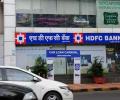
HDFC Bank on Wednesday reported a 2.3 per cent year-on-year rise in its consolidated net profit to Rs 17,657 crore for the October-December quarter, restricted by slower loan growth. On a standalone basis, the largest private sector lender's net profit came at Rs 16,735.50 crore for the period, up from Rs 16,372.54 crore in the year-ago period, but marginally down from the preceding quarter's Rs 16,820.97 crore.
